

Most indie authors pour months, sometimes years, into writing a book and then assume the launch is something they have to tackle alone. That assumption quietly kills more book launches than bad covers or weak blurbs ever will. A book launch team changes that equation completely. Understanding what is a book launch team, and how to build one that actually works, is one of the most practical steps you can take to give your book a real shot at visibility, credibility, and sales from day one.
Table of Contents
- Key takeaways
- What is a book launch team and why it matters
- Building the infrastructure and timeline
- How to recruit, organize, and motivate your team
- Launch week best practices
- Common pitfalls to avoid
- My honest take on launch teams
- How Booksculpt helps you launch with confidence
- FAQ
Key takeaways
| Point | Details |
|---|---|
| Launch teams drive early reviews | Books with 20-50 pre-launch reviews significantly outperform those with zero, making team recruitment non-negotiable. |
| ARC teams and launch teams differ | ARC teams focus on reading and reviewing; launch teams also handle social amplification and word-of-mouth promotion. |
| Timing matters more than size | Build your infrastructure 6-12 months out and run an intensive 30-day execution window close to launch. |
| Content kits multiply participation | Providing pre-written posts and graphics makes it easy for team members to show up and help consistently. |
| Relationships outlast the launch | A well-managed launch team becomes a loyal reader community that supports every future book you release. |
What is a book launch team and why it matters
A book launch team is a group of readers, fans, and supporters who agree to help you promote your book around its release date. They read advance copies, post honest reviews, share your announcement on social media, and generally help spread the word within their own networks. Think of them as your street team, except the street is the internet and the reach is potentially enormous.
The role of a book launch team goes well beyond just collecting reviews. Members might share your cover reveal, post about the book on their own social channels, send personal recommendations to friends, or even show up to virtual launch events. The combined effect of all those small actions creates the kind of organic buzz that no paid ad campaign can fully replicate.

One distinction worth understanding early: an ARC team and a launch team are related but not identical. ARC teams focus on reviews, meaning their primary job is to read your Advance Reader Copy and post a review on launch day or shortly before. A broader launch team includes those reviewers but also pulls in people willing to do social amplification, share newsletters, and participate in promotional activities. You can have both functions within one group, but knowing the difference helps you set the right expectations with each member.
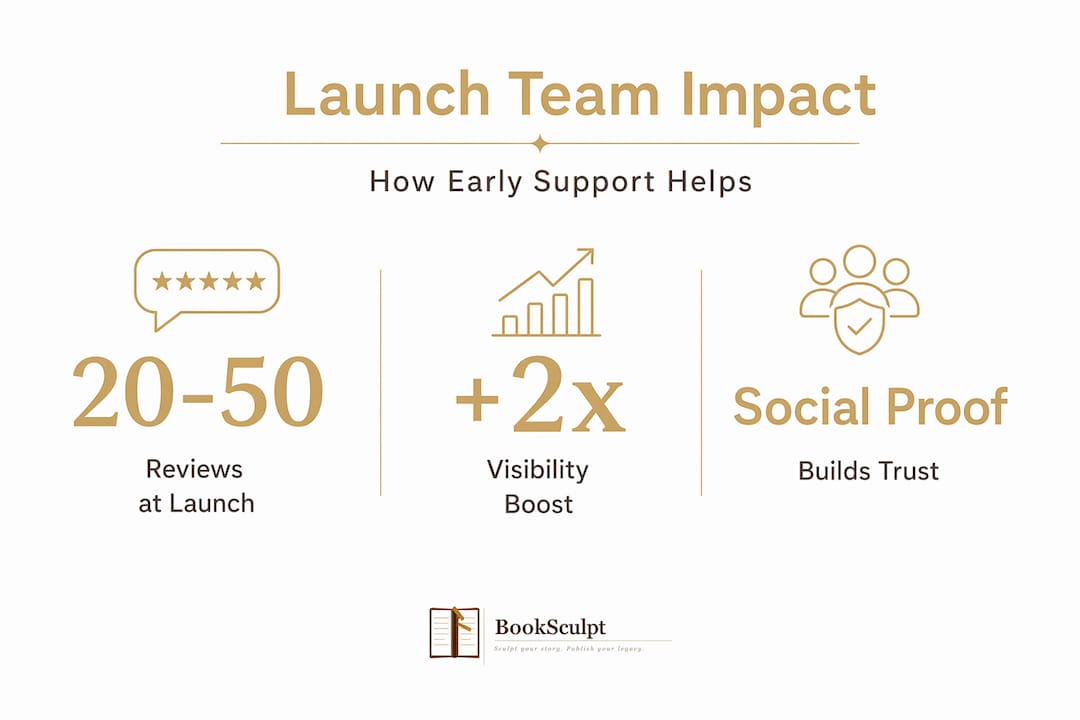
Why does any of this matter for your book's sales? Amazon's algorithm rewards books that show early, consistent engagement. A title that launches with a wave of genuine reviews signals to the platform that readers are interested, which pushes the book higher in search results and also-bought recommendations. Books with 20-50 reviews dramatically outperform those with zero, and that gap in visibility compounds over time. Getting those first reviews is not a vanity metric. It is a core part of your book launch strategy.
The benefits of book launch teams also include something harder to measure but equally real: social proof. When a reader lands on your book page and sees dozens of thoughtful reviews already there, they feel confident clicking "buy." That confidence is built by your team before you ever spend a dollar on advertising.
Building the infrastructure and timeline
One of the biggest mistakes authors make is waiting until the month before launch to think about their team. Effective book marketing team building requires a much longer runway. Infrastructure should be built 6-12 months before your publication date, with the intensive execution happening in the final 30 days.
Here is a practical timeline to work from:
- Months 6-12 before launch: Start growing your email list and social media following. These are the pools you will recruit from. Post consistently, engage with readers in your genre, and let people know a book is coming.
- Months 3-6 before launch: Begin identifying potential launch team members. Reach out to engaged followers, past readers, and genre community members. Create a simple sign-up form using Google Forms or a similar tool to capture interest.
- 4-6 weeks before launch: Send digital ARCs to confirmed team members. Sending ARCs 4-6 weeks out gives readers enough time to finish the book and write a thoughtful review without feeling rushed.
- 1-2 weeks before launch: Run a soft launch period. Share the book with your team before the public release date. This lets you catch any last-minute formatting issues and allows early purchases and reviews to start accumulating before the official launch day.
- Launch week: Activate the full team with reminders, shareable content, and specific asks. This is your 30-day intensive window in action.
Pro Tip: Use a dedicated Facebook Group or Discord server for your launch team. It keeps communication organized, builds community among members, and makes it easy to share updates, graphics, and reminders in one place.
Tools like Booksprout help you manage ARC distribution and track who has received a copy and who has posted a review. Google Forms works well for initial sign-ups and collecting mailing addresses if you are sending physical copies. The goal is to avoid managing everything manually in your email inbox, which leads to missed follow-ups and lost momentum.
How to recruit, organize, and motivate your team
Knowing how to build a launch team starts with knowing who to ask. Your best candidates are people who already care about you or your genre. That includes:
- Existing readers who have reviewed or messaged you about previous books
- Newsletter subscribers who open your emails consistently
- Social media followers who comment, share, and engage with your posts
- Genre community members from reader groups, book clubs, or forums in your niche
- Fellow authors in your genre who understand the value of mutual support
Once you have identified potential members, segment them by what they are willing and able to do. Some people will read and review but not post on social media. Others are social media active but slow readers. Matching the ask to the person's strengths makes everyone more likely to follow through.
The actual ask matters more than most authors realize. Supporters want to help but need a clear, specific invitation. A vague "would you help spread the word?" gets ignored. A specific "I'm looking for 20 readers to receive a free copy of my new thriller in exchange for an honest review on Amazon by October 15th" gets responses. Be direct, explain what you need, and make it easy to say yes.
Once your team is assembled, give them everything they need to participate without extra effort on their part. Shareable graphics and pre-written posts dramatically increase team participation because they remove the friction of having to create content from scratch. A simple content kit might include:
- Two or three pre-written social media captions in different lengths
- A cover image sized for Instagram, Facebook, and Twitter/X
- A short blurb they can copy into a newsletter or email
- A list of relevant hashtags for your genre
Pro Tip: Frame your ask around the reader's experience, not your need. "I think you'd genuinely enjoy this one and your opinion would mean a lot" lands better than "I need reviews." People respond to being valued, not recruited.
Maintaining motivation throughout the launch period also requires consistent communication. Send weekly updates, celebrate milestones publicly in your team group, and thank people by name. Viewing your team as a relationship engine rather than a one-time marketing tool changes how you show up for them, and they notice.
Launch week best practices
Launch week is when your book marketing team shifts from preparation to execution. Coordination during this window determines how much momentum you actually build.
| Activity | Timing | Why it matters |
|---|---|---|
| Send final reminder to team | 3 days before launch | Catches members who forgot and prompts action |
| Encourage staggered review posting | Days 1-7 of launch | Staggered reviews signal steady interest to algorithms |
| Share social content kit | Launch day morning | Gives team ready-to-post content at peak visibility |
| Track review submissions | Daily during launch week | Lets you follow up with members who have not posted yet |
| Post-launch thank you | Day 8-10 | Closes the loop and strengthens the relationship |
One detail that gets overlooked: verified purchase reviews carry more weight on Amazon than reviews from free copies alone. Encourage team members who are willing to purchase the book, even at a low price, to do so before posting their review. You can offer a small gift card or a signed bookplate as a thank-you for members who go that extra step.
Sustained post-launch marketing matters just as much as the launch day itself. Keep sharing content, asking satisfied readers to leave reviews, and engaging with anyone who posts about the book. The algorithm rewards ongoing engagement, not just a single spike on day one.
Common pitfalls to avoid
Even well-intentioned authors run into the same problems repeatedly. Here are the ones worth watching for:
- Starting too late. Recruiting a launch team two weeks before your release date does not give members enough time to read, review, and prepare. Start months earlier.
- Confusing ARC and launch team roles. If you only send ARCs and expect social promotion, you will be disappointed. Be explicit about what each member is being asked to do.
- Skipping the content kit. Without ready-made materials, most team members will mean to post but never get around to it. Make participation effortless.
- Failing to track contributions. Active management with tracking systems significantly improves review rates. If you do not know who has posted, you cannot follow up with who has not.
- Letting fear stop you from asking. Many authors avoid building a launch team because they worry about burdening people. That fear is understandable, but it is also holding you back. Most readers genuinely want to support authors they like.
My honest take on launch teams
I have watched authors spend thousands on ads for a book that had three reviews on launch day and wonder why the campaign flopped. The ads were not the problem. The foundation was missing.
What I have come to believe, after seeing dozens of launches succeed and fail, is that a launch team is not really a marketing tactic. It is a trust network. The readers on your team are not just clicking "post review." They are putting their personal credibility behind your book when they recommend it to their own followers and friends. That is worth more than any impression metric.
The authors who build the strongest launch teams treat them like a community from day one. They share behind-the-scenes updates during the writing process, ask for input on covers or titles, and make members feel like insiders rather than volunteers. By the time launch day arrives, those readers are genuinely excited. They do not need to be reminded to post because they want to.
I also think the fear of asking for help is the single most underestimated obstacle in indie publishing. Most supporters want to help if you ask clearly and make it easy. The authors who internalize that truth and act on it build something that outlasts any single book. They build a reader community that shows up launch after launch, year after year.
That is the real benefit of a book launch team. Not just the reviews on day one, but the relationships that carry you forward.
— Soumitra
How Booksculpt helps you launch with confidence
You have poured your heart into writing this book. The last thing you need is to manage a launch team from a tangle of spreadsheets, email threads, and forgotten follow-ups.

Booksculpt is built for exactly this moment. The platform's integrated marketing suite gives you tools to organize your launch team communications, automate reminder sequences, and track review submissions without switching between five different apps. From ARC distribution to content drip campaigns, everything lives in one place. You can see how it works and explore the full feature set designed to take the operational weight off your shoulders so you can focus on what matters: connecting with readers. Plans start at $19/month, making professional-grade launch support accessible for every indie author.
FAQ
What does a book launch team do?
A book launch team reads advance copies of your book, posts honest reviews on launch day, and promotes the book across their social media and personal networks. Their combined effort creates early visibility and social proof that drives organic sales.
How many people should be on a book launch team?
There is no fixed number, but aiming for 20-50 active members gives you enough reviews to meaningfully impact platform algorithms. Quality and follow-through matter more than raw headcount.
When should I start building my launch team?
Start building your infrastructure 6-12 months before your publication date and send ARCs to confirmed members 4-6 weeks before launch. Waiting until the final weeks leaves too little time for members to read and review.
What is the difference between an ARC team and a launch team?
An ARC team focuses specifically on reading your Advance Reader Copy and posting reviews. A launch team is broader and also includes members who promote the book on social media, share newsletters, and help build word-of-mouth buzz around the release.
Do I need to pay my launch team members?
No. Most launch team members participate in exchange for a free advance copy of the book. Some authors offer small bonuses like signed bookplates or gift cards for members who make a verified purchase, but payment is not expected or standard.