

If you've finished writing your book and started researching how to get it published, you've almost certainly stumbled across KDP Direct Publishing. What is KDP direct publishing, exactly? Kindle Direct Publishing is Amazon's free self-publishing platform that lets any author upload a manuscript, set a price, and have their book available to millions of readers worldwide, often within 72 hours. But here's what most first-timers miss: KDP gets your book on the shelf. What happens after that is entirely up to you.
Table of Contents
- Key takeaways
- What is KDP direct publishing and how it works
- Benefits and real limitations of KDP
- Marketing on KDP: what actually drives sales
- Common mistakes that trip up new KDP authors
- Tools and resources that make KDP publishing easier
- My honest take on KDP as a publishing platform
- Take the stress out of KDP publishing with Booksculpt
- FAQ
Key takeaways
| Point | Details |
|---|---|
| KDP is free to use | You pay nothing upfront; Amazon takes a percentage only when your book sells. |
| Royalties beat traditional publishing | KDP offers up to 70% royalties, compared to 10-15% from traditional publishers. |
| Marketing is your job | Amazon will not promote your book automatically; sales depend on your own marketing effort. |
| Formatting errors cause delays | New authors should plan for a 30-day review window due to potential formatting rejections. |
| Niche validation saves time | Researching market demand before writing dramatically improves your odds of making sales. |
What is KDP direct publishing and how it works
Kindle Direct Publishing is Amazon's self-publishing arm, and it operates on a print-on-demand model. That means Amazon only prints a physical copy of your book when a customer actually orders one. No warehousing. No inventory risk. No boxes of unsold books sitting in your garage.
You can publish three formats through KDP: eBooks (delivered to Kindle devices and apps), paperbacks, and hardcovers. Most authors publish at least the eBook and paperback versions together to reach the widest possible readership.
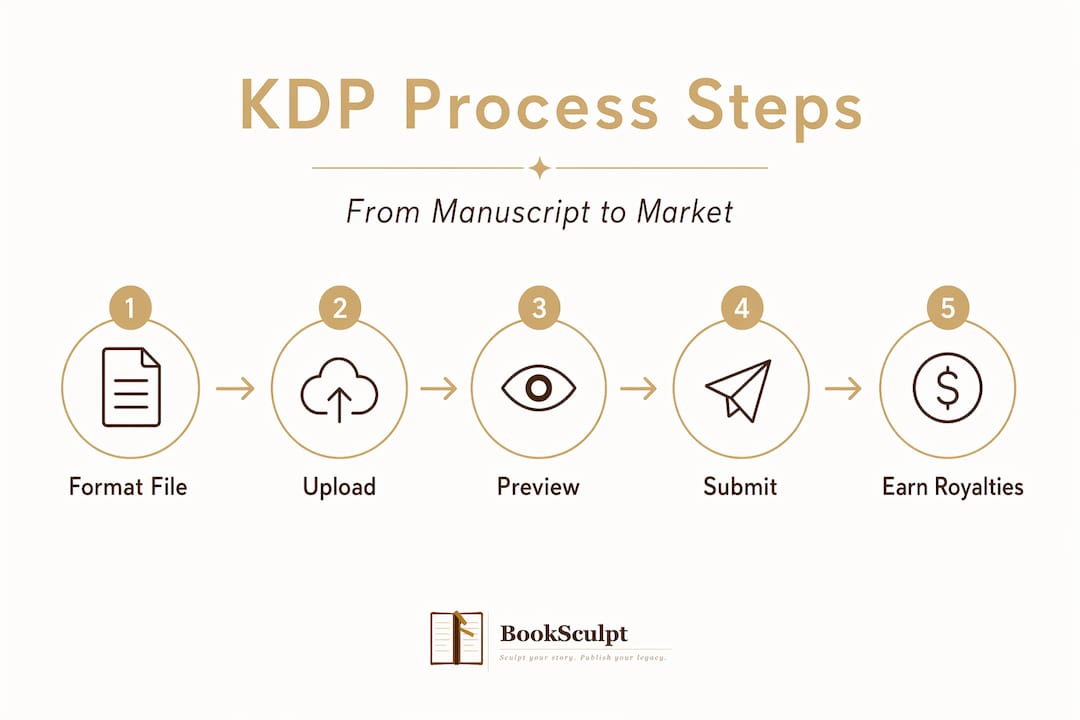
Here is the step-by-step KDP publishing process from start to finish:
- Create a KDP account. Go to kdp.amazon.com and sign in with your Amazon credentials. Fill in your tax information right away. US authors need a W-9 form; non-US authors need a W-8BEN. Skipping this step blocks royalty payments entirely, so do not put it off.
- Enter your book details. Title, subtitle, series name if applicable, author name, and a book description. Your description functions like a sales page, so treat it that way.
- Upload your manuscript. KDP accepts Word documents (.docx) and PDF files. For eBooks, Amazon's free Kindle Create tool can convert your manuscript, but read the note below.
- Design and upload your cover. KDP provides a basic Cover Creator tool, but a professionally designed cover makes a significant difference in click-through rates.
- Choose your ISBN. KDP offers a free ISBN, but using it means Amazon is listed as your publisher indefinitely. If you want your own imprint name on the book, purchase your own ISBN through Bowker.
- Set your pricing and royalty tier. Books priced between $2.99 and $9.99 qualify for the 70% royalty rate. Books priced outside that range earn only 35%.
- Publish and wait for review. Amazon typically reviews and approves new books within 24 to 72 hours, though new authors may experience longer waits.
That last point deserves more attention. If your manuscript has formatting problems, Amazon will reject it and ask you to fix the issue before resubmitting. Each review attempt can take up to 10 days, and multiple rejections can push your total wait time to 30 days. If you have a hard launch date planned, build that buffer in from the start.
Pro Tip: Before uploading, open your manuscript in Kindle Previewer (Amazon's free desktop tool) and read through every page. What looks clean in Word sometimes breaks in conversion.
Benefits and real limitations of KDP
KDP gives independent authors capabilities that would have required a publisher just 20 years ago. That said, going in with clear eyes about both the upsides and the limitations will save you a lot of frustration.

What KDP does well
The royalty structure is genuinely impressive. Traditional publishing typically pays authors 10-15% in royalties. KDP pays up to 70%. For an author selling a $9.99 eBook, that is roughly $6.99 per sale versus about $1.50 from a traditional deal. Over time, that difference is enormous.
The print-on-demand model removes one of the biggest barriers to self-publishing: upfront cost. You do not need to pre-order 500 copies and hope they sell. You can also update your book at any time. Spot a typo six months after publishing? Upload a corrected file the same day.
| Factor | KDP self-publishing | Traditional publishing |
|---|---|---|
| Royalty rate | Up to 70% | 10-15% |
| Upfront cost | $0 | Often requires agent, may advance |
| Time to market | Days to weeks | 1-2 years |
| Creative control | Full | Limited |
| Marketing support | None (author's responsibility) | Some, varies widely |
| Distribution reach | Amazon worldwide | Bookstores, Amazon, global |
Where KDP falls short
KDP's distribution is Amazon-centric. Your book will not automatically appear on Barnes and Noble, Apple Books, or Kobo unless you distribute through a third-party aggregator. If you enroll in KDP Select (Amazon's exclusivity program that unlocks Kindle Unlimited access and promotional tools), you actually agree to sell your eBook exclusively on Amazon for 90-day windows.
Print quality on KDP paperbacks is generally solid for most genres, but it can fall short for books with complex interior layouts, heavy color images, or photography. Authors producing that type of content sometimes use a separate print service for higher-quality output.
Pro Tip: If you want to maintain control of your publishing imprint for future books or a potential traditional deal, buy your own ISBN upfront. It costs around $125 for a single ISBN through Bowker, but it protects your author brand long-term.
Marketing on KDP: what actually drives sales
Here is the uncomfortable truth that catches most new authors off guard: no algorithm will market your book automatically. Amazon has millions of titles. Your book, fresh off the press with zero reviews and no sales history, is invisible. Real authors have reported results like only 5 eBook and 3 paperback sales after publishing without a marketing plan. That does not mean KDP does not work. It means marketing is entirely your responsibility.
Here is what actually moves the needle:
- Validate your niche before you write. Authors who analyze Amazon search suggestions and competitor reviews before writing a single word have a much higher success rate. You want to confirm people are searching for the type of book you plan to write.
- Build an ARC team. An Advance Reader Copy team consists of readers who receive a free copy before launch in exchange for an honest review on launch day. Early reviews build trust signals that increase clicks and conversions substantially.
- Use Amazon Ads strategically. KDP's advertising platform lets you run sponsored product ads directly on Amazon. Start with automatic campaigns to discover which keywords convert, then shift budget toward manual campaigns targeting those terms.
- Optimize your metadata. Your book's keywords and categories control where Amazon places your book in search results. Choose two categories where your book can realistically reach bestseller status in a subcategory, and rotate your seven keywords based on what readers actually search for.
- Build your author platform. A simple author website and email newsletter give you a direct line to readers that does not depend on Amazon's algorithm. Social media can support this, but an email list is where engaged readers actually live.
Pro Tip: Use Publisher Rocket (a keyword research tool) or simply type your book topic into Amazon's search bar and note the autocomplete suggestions. Those suggestions are real searches from real buyers and belong in your keyword fields.
Common mistakes that trip up new KDP authors
Most publishing problems are avoidable. The ones that hurt new authors most are not creative mistakes. They are process mistakes.
- Skipping a final proofread of the converted file. Kindle Create, Amazon's free formatting tool, occasionally introduces subtle typos that were not in your original manuscript. A missing letter here, a broken word there. Always proofread the Kindle Previewer output, not just your Word document.
- Choosing the wrong categories. Many authors pick the broadest possible categories, hoping for more exposure. The reality is that broad categories are harder to rank in. Choose specific subcategories where competition is lower and a bestseller tag is within reach.
- Uploading a low-quality cover. Covers are the first thing a potential reader sees, especially on a small phone screen. A cluttered or amateur cover tells readers the book inside might not be worth their time either.
- Not completing tax forms before publishing. Incorrect or missing tax paperwork blocks timely payments. US authors file a W-9; everyone else files a W-8BEN. Get this done on day one.
- Planning a launch for tomorrow. Build a 30-day buffer between your planned finish date and your actual launch date. That window absorbs formatting rejections, review delays, and last-minute edits without blowing up your schedule.
Pro Tip: Order a physical proof copy before approving your paperback for sale. Seeing your book in hand often reveals margin issues, font problems, and cover bleed errors that look fine on screen.
Tools and resources that make KDP publishing easier
Once you understand the KDP publishing process, the next challenge is efficiency. Writing a book, formatting it properly, designing a cover, and then marketing it across multiple channels is a lot to manage solo. The good news is that the right tools can compress weeks of frustrating technical work into hours.
Here is a practical toolkit to consider as you plan your publishing workflow:
- Formatting tools: Properly formatted manuscripts reduce rejection risk significantly. Look for tools that output KDP-ready files in both EPUB (for eBooks) and PDF (for print), handling margins, headers, and image DPI requirements automatically.
- Cover design: If your budget is limited, tools like Canva offer book cover templates. For a more polished result, AI-powered cover generators trained on genre conventions produce covers that actually look like they belong on the shelf.
- Keyword and category research: Beyond Amazon's autocomplete, dedicated research tools help you discover low-competition, high-demand categories your book can rank in faster.
- Author communities: Reddit communities like r/selfpublish and genre-specific Facebook groups are full of authors sharing real launch data and practical advice. These communities are free and genuinely useful.
- Email list setup: Even a basic free plan on an email platform like MailerLite gives you the ability to build a reader list before your next book launch. Start this before your first book goes live, not after.
A platform that handles writing assistance, formatting, cover generation, and publishing in one place can save you the $1,500 to $5,000 that authors typically spend piecing together individual services. Having a complete author workflow in one place means fewer tools to learn and more time spent writing.
Pro Tip: Block your first week post-launch for marketing only. Answer reader messages, run a price promotion, reach out to book bloggers in your genre, and monitor your keyword rankings. The momentum you build in week one has a disproportionate effect on your book's long-term visibility.
My honest take on KDP as a publishing platform
I've watched hundreds of authors go through the KDP experience, and the pattern is almost always the same. Authors pour enormous energy into writing and editing, then publish on KDP and expect the sales to follow. When they do not, the platform gets blamed. But KDP did exactly what it promised. It got the book live. The gap was almost always in marketing.
What I've learned from observing successful KDP authors is that the ones who gain real traction treat publishing as a starting line, not a finish line. They spend as much time building their reader audience as they did writing the book. Many of today's bestselling self-published authors used KDP as a side entrance to prove sales potential, then used that track record to attract traditional publishing interest. That reframe changes everything.
My honest advice: validate your niche before writing a single chapter, build your ARC team before you finish the manuscript, and treat your metadata like a live marketing asset you revisit every few months. KDP is a genuinely powerful platform. But it rewards prepared authors, not just prolific ones.
— Soumitra
Take the stress out of KDP publishing with Booksculpt
You've put your heart into writing this book. The last thing you need is to lose weeks of momentum wrestling with formatting files, cover specs, and keyword research across a dozen separate tools.
Booksculpt is built specifically for independent authors navigating the KDP publishing process. The platform brings AI writing assistance, automated KDP formatting, AI-powered cover generation, and a marketing suite into one subscription starting at $19/month. That replaces the $1,500 to $5,000 most authors spend piecing together individual services for a single book. Explore the full platform features to see how Booksculpt handles the technical heavy lifting so you can stay focused on what you do best: writing. Plans are available for every stage, from first-time authors to full-time publishing professionals. See which plan fits your goals and start publishing with confidence.
FAQ
What is KDP direct publishing?
KDP Direct Publishing (Kindle Direct Publishing) is Amazon's free self-publishing platform that allows authors to publish eBooks, paperbacks, and hardcovers and make them available to Amazon customers worldwide, often within 72 hours.
How much money can you make on KDP?
Revenue from KDP varies widely, but the royalty structure is favorable: authors earn up to 70% on eBooks priced between $2.99 and $9.99. Actual earnings depend almost entirely on marketing effort and niche demand.
Is KDP profitable for new authors?
KDP can be profitable, but success is not automatic. Authors who validate their niche before writing and actively market their books consistently outperform those who publish and wait.
How long does KDP publishing take?
Most books are reviewed and approved within 24 to 72 hours. New authors with formatting errors may face multiple review cycles, making a 30-day buffer a smart planning strategy.
Does Amazon market your book for you on KDP?
No. Amazon provides the platform and distribution, but marketing is entirely the author's responsibility. Authors who publish without a marketing plan frequently see very few sales regardless of book quality.