

Genre fiction writing with AI is one of the most exciting shifts in independent publishing right now. You've poured your heart into building worlds and characters, yet the blank page still wins some days. AI tools can change that equation without handing your creative voice over to a machine. This guide walks you through the exact tools, workflows, and safeguards you need to write faster, think bigger, and stay fully in control of your story.
Table of Contents
- Key takeaways
- Genre fiction writing with AI: tools and setup
- A step-by-step AI writing workflow
- Common pitfalls in AI genre fiction writing
- Verification before you publish
- My honest take on AI and genre fiction
- How Booksculpt supports your AI writing workflow
- FAQ
Key takeaways
| Point | Details |
|---|---|
| Prepare before you prompt | Build a character and world bible before touching any AI tool to prevent generic, inconsistent output. |
| Rotate AI models by task | Use different models for prose, plot logic, and continuity to get the best results from each. |
| Draft scene by scene | Keep AI output inside manageable context windows to avoid narrative drift across long manuscripts. |
| Human edits are non-negotiable | Final line edits restore emotional depth and voice that AI consistently flattens or loses. |
| Know your copyright position | Only work with meaningful human creative input receives U.S. copyright protection. |
Genre fiction writing with AI: tools and setup
Before you write a single scene with AI assistance, you need the right tools and a clear creative foundation. Skipping this step is the single biggest reason writers end up with generic output that sounds like every other AI novel on the market.
Choosing your AI writing tools
The best AI tools for writers in genre fiction each have distinct strengths. Here is a practical comparison to help you decide where to start:
| Tool | Best for | Genre fiction strength |
|---|---|---|
| Claude Opus | Prose style and voice | Nuanced character dialogue, literary tone |
| GPT-5 | Plot logic and structure | Three-act scaffolding, pacing analysis |
| Gemini 2.5 Pro | Continuity and research | World-building consistency, fact checks |
| Sudowrite | Fiction-specific drafting | Scene expansion, sensory detail prompts |
No single tool does everything well. Rotating between models for specific tasks improves output quality across the board. Think of it like hiring specialists instead of one generalist.
Setting your creative parameters
Before you open any AI tool, write down your genre, subgenre, tone, core themes, and the emotional experience you want readers to have. A thriller set in 1970s Buenos Aires needs completely different prompting than a cozy mystery in a Vermont bookshop.

The single most important preparation step is building a character and world bible. This living document should include character names, physical descriptions, speech patterns, backstory, relationships, and world rules. Reference it in every AI prompt. Without it, your AI output will drift toward stock characters and predictable settings within a few sessions.
Pro Tip: Write a one-page creative brief for each project before your first AI session. Include your protagonist's wound, the story's central question, three non-negotiable tone words, and two authors whose style you want to channel. Paste this brief at the top of every new AI conversation.
A step-by-step AI writing workflow
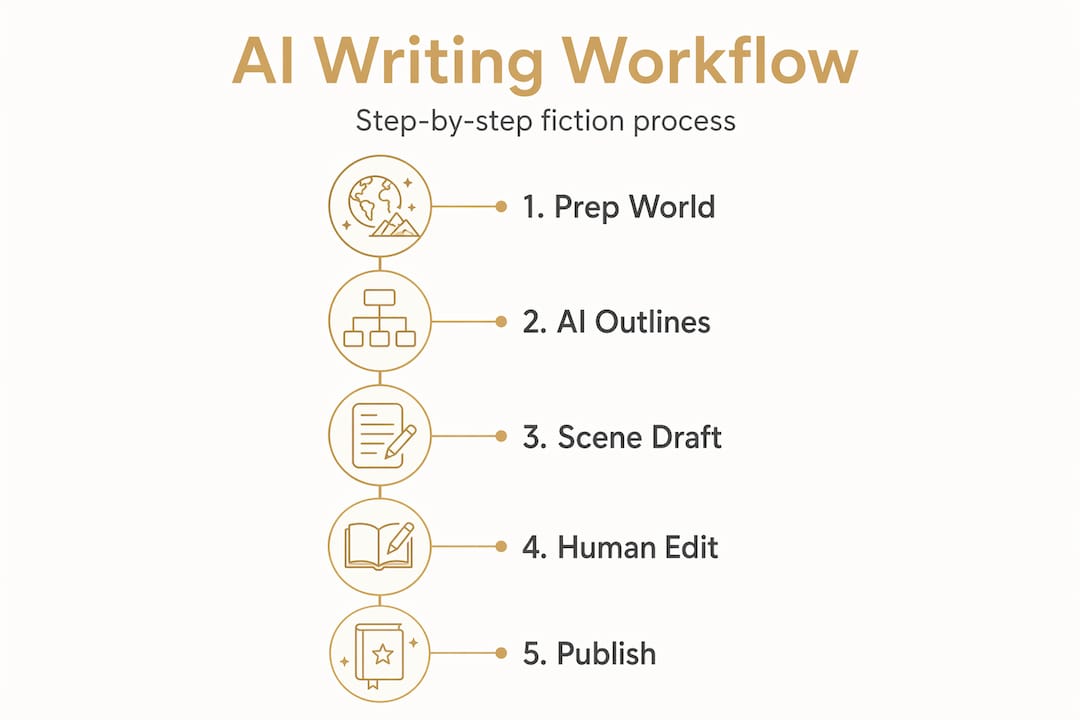
AI-assisted storytelling works best when you treat AI as a drafting partner with a specific job description, not a ghostwriter. Here is a workflow that keeps you in the creative driver's seat from premise to final draft.
-
Start with brainstorming. Feed your creative brief to your AI tool and ask for ten premise variations, not one. You are looking for the idea that surprises you, not the safest option the AI defaults to.
-
Build your outline collaboratively. Use GPT-5 or a plot-focused model to stress-test your three-act structure. Ask it to identify where tension drops, where your protagonist lacks agency, and where subplots contradict each other.
-
Set emotional targets before each scene. Before drafting any scene, tell the AI what emotional state you want the reader in at the end of it. "The reader should feel dread mixed with reluctant hope" is far more useful than "write chapter three."
-
Draft scene by scene. The most effective approach to AI-assisted fiction is scene-by-scene drafting to stay within AI context windows and prevent narrative drift. Long-form AI generation across tens of thousands of words produces inconsistencies that take longer to fix than writing from scratch.
-
Rotate your models. Use Claude for prose-heavy scenes where voice matters most. Switch to Gemini when you need continuity checks across chapters. This model rotation approach, using dedicated models per task, consistently produces cleaner manuscripts.
-
React critically to every output. Read AI drafts as a skeptical editor, not a grateful recipient. Mark every sentence that sounds generic, every metaphor you have read before, and every emotional beat that feels unearned.
-
Do your human line edits last. This is not optional. Final human line edits focusing on emotional resonance and individual voice are what separate publishable AI-assisted fiction from the forgettable pile.
Pro Tip: After receiving any AI draft, read it aloud before editing. Your ear will catch the flat sentences and borrowed rhythms faster than your eye will. Mark anything you would not say in your own voice and rewrite it before moving on.
Experts consistently recommend keeping humans central to creativity, using AI to accelerate tedious parts like outlining and continuity checks rather than replacing the imaginative core of the work.
Common pitfalls in AI genre fiction writing
Even writers who use AI thoughtfully run into the same problems. Knowing what to watch for saves you weeks of frustrating rewrites.
AI dependency and creative atrophy
The most underrated risk in creative writing with AI is losing your own narrative instincts. If you reach for an AI prompt every time you face a difficult story decision, you stop developing the creative muscle that makes your fiction distinctive. Experts recommend using AI to brainstorm and test ideas while humans maintain premise, voice, and final editing. Use AI to generate options. You make the choices.
The sanitized story problem
AI has a well-documented tendency to flinch. It softens dark themes, explains cruelty rather than letting readers feel it, and steers toward tidy resolutions. Genre fiction lives in moral complexity and emotional discomfort. A horror novel that avoids genuine dread is not horror. A war thriller that sanitizes violence is not honest. You will need to push back on AI's instinct toward safety in every emotionally demanding scene.
Long-form coherence breaks down
AI models often fail to maintain consistent plot logic across 80,000 or more words. Character motivations shift, timeline errors appear, and subplots get dropped. This is not a flaw you can prompt your way out of. It is a structural limitation that requires human oversight at the chapter and manuscript level.
Here are the most practical troubleshooting steps to keep your manuscript on track:
- Run a continuity audit every 10,000 words using a dedicated AI model and your world bible
- Keep a running "story rules" document that you update after every session
- Never let AI resolve a plot problem you have not already solved conceptually yourself
- Read each chapter's opening and closing sentence together before moving forward
- Flag any scene where a character's behavior surprises you in a way you did not intend
Flattery over feedback
AI editing tools often provide sycophantic responses, missing the structural critique your manuscript actually needs. If you ask an AI to evaluate your chapter and it tells you it is excellent with minor suggestions, treat that as a yellow flag. Push harder. Ask specifically what the weakest scene is, what the most predictable moment is, and what a skeptical reader would put the book down over.
Verification before you publish
Getting your AI-assisted manuscript to the finish line means more than good prose. You need to confirm your legal position, your platform compliance, and your creative ownership before you hit publish.
| Verification step | What to check | Why it matters |
|---|---|---|
| Copyright audit | Identify which sections had heavy human editing vs. AI generation | Only human-authored work receives U.S. copyright protection |
| Platform disclosure | Review Amazon KDP and other platform policies | AI-assisted content with meaningful human input does not require KDP disclosure |
| Voice consistency check | Read manuscript aloud from start to finish | Flat or inconsistent voice signals under-edited AI sections |
| Originality pass | Run key passages through originality tools | Confirm no unintentional replication of training data patterns |
| Emotional resonance test | Share with beta readers before launch | Human readers catch what AI and authors miss after close editing |
The copyright question is the one most writers get wrong. Under U.S. law, pure AI-generated works are not copyrightable. The more meaningful your human creative input, the stronger your protection. Heavy editing, structural decisions, and original character development all strengthen your claim. Document your creative process as you go.
For platform compliance, Amazon KDP requires internal disclosure only for fully AI-generated content. If you have meaningfully shaped the work, you are in a different category. Still, read the current platform policies before every upload since they update regularly.
My honest take on AI and genre fiction
I've watched a lot of writers adopt AI tools with enormous enthusiasm, then quietly abandon them six months later feeling like their work got worse, not better. What I've learned from that pattern is that the problem almost never comes from the AI. It comes from how writers position themselves in relation to it.
The writers I've seen get genuinely great results treat AI the way a novelist might treat a research assistant or a writing group. They bring the vision. They make the hard calls. They do the emotional labor of figuring out what the story is really about. AI handles the mechanical scaffolding and the "what if" generation. That division of labor works.
What does not work is using AI to avoid the parts of writing that feel hard. The blank page is hard because you are trying to say something true about human experience. AI cannot do that for you, and asking it to is where creative depth disappears. Genre fiction's formulaic structure makes it especially vulnerable to this trap. Romance, thriller, fantasy, all of these genres have conventions that AI knows well. It will give you a competent version of those conventions every time. Your job is to give readers something that surprises them within those conventions. That requires you.
My advice is to stay uncomfortable. Keep writing scenes that scare you a little. Use AI to go faster, not to avoid going deep.
— Soumitra Belani
How Booksculpt supports your AI writing workflow
If you are ready to put this workflow into practice, Booksculpt was built for exactly this moment in independent publishing. The platform brings together AI writing assistance, a built-in series bible manager, smart editing, automated KDP formatting, AI cover generation, and an audiobook studio in one place.

You do not need five separate subscriptions or a technical background to use it. Booksculpt's full feature suite maps directly to the workflow in this article, from premise development through final formatting and distribution. The series bible tool alone solves the consistency problem that trips up most AI-assisted manuscripts. Plans start at $19/month, replacing what typically costs $1,500 to $5,000 per book when you hire it out. You can explore how it works and see exactly where it fits into your process before committing to anything. For writers who are serious about publishing more and spending less time on the mechanics, it is worth a close look at the pricing options.
FAQ
What is the best way to start genre fiction writing with AI?
Build a character and world bible first, then use AI for brainstorming and scene drafting while keeping all major creative decisions yourself. Starting with clear creative parameters prevents the generic output that frustrates most new AI users.
Do I need to disclose AI use when publishing on Amazon KDP?
Amazon KDP requires disclosure only for fully AI-generated content, not for AI-assisted work where you have provided meaningful human creative input. Always check the current platform policy before publishing since requirements can change.
Can AI write an entire novel without human editing?
AI models currently struggle to maintain consistent plot logic across 80,000 or more words, making human oversight and editing necessary for any publishable novel-length work. Scene-by-scene drafting with regular continuity audits is the most reliable approach.
Will using AI hurt my copyright protection?
Under U.S. copyright law, only works with meaningful human creative input are protected. The more you shape, edit, and originate the work, the stronger your copyright claim, so thorough human editing is both an artistic and legal priority.
How do I stop AI from producing flat or sanitized fiction?
Push back on AI's default tendency to soften difficult moments by explicitly naming the emotional discomfort you want readers to feel in your prompts, and always do a final human line edit to restore the emotional risk that AI tends to smooth over.